

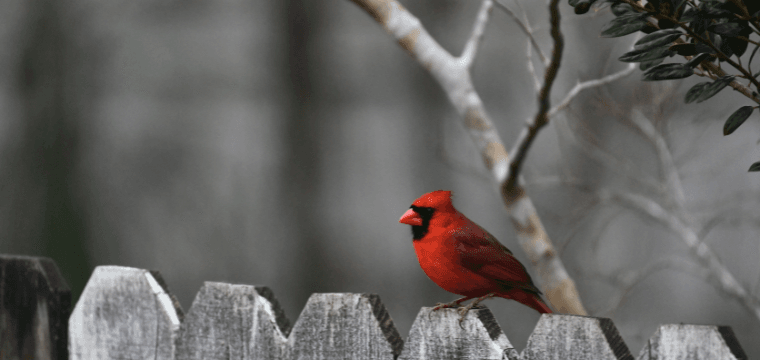
Become a birder without leaving your block!
Learn about ornithology, the study of birds.
Ornithologists learn all about birds, including biology, behavior, and identification. The neighborhood around your home is a habitat for a number of bird species. Nebraska is a great place to learn about ornithology because many species of birds visit our area as they migrate. Typically, birds that fly through and to Nebraska travel south during the winter to find food, and fly north in the spring for ideal nesting habitat. Learn more about bird migration from this interactive map from All About Birds.
You don’t have to know a lot about birds to do these activities, but if you want to learn more, check out this guide to bird identification and bird-watching from Cornell University. You can even download their bird identification app to easily identify birds on the go.
Below are three different activities to explore the birds that call your neighborhood home! Create your very own bird guide, take your family for a “Sound Walk,” or make a pair of homemade binoculars.
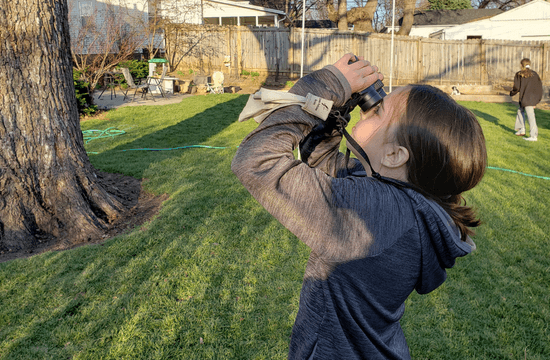
CREATE A NEIGHBORHOOD BIRD GUIDE
What you need:
- Drawing paper
- Markers, colored pencils, or crayons
- Internet access or a bird identification guide
How to do it:
Creating your own bird identification guide is a fun way to learn bird identification. Using a bird identification guide like this one from Nebraska Game and Parks or this guide from the Audobon Society, come up with a list of birds that are common in your neighborhood. Draw a picture of each bird. Your bird drawings don’t need to be perfect, but make sure to clearly draw distinguishing characteristics, such as a cardinal’s crown or a robin’s red breast. Consider the color of the head and wings, the shape of the beak, etc. If the male and female birds look different, consider including both genders on your chart.
Suggested Nebraska backyard birds:
- American robin
- Northern cardinal
- House finch
- Black-capped chickadee
- Blue jay
- Dark-eyed junco
- Northern flicker
- Hairy woodpecker
- Morning dove
- Cooper’s hawk
- Grackle
- Starling
- American goldfinch
- House sparrow
- American tree sparrow
Once you’ve finished your neighborhood bird guide, hole punch the left side edge of each page and bind them together with a few pieces of yarn. Keep your guide near your favorite bird-watching spot at home for reference, and continue adding pages as you discover new species in your backyard.
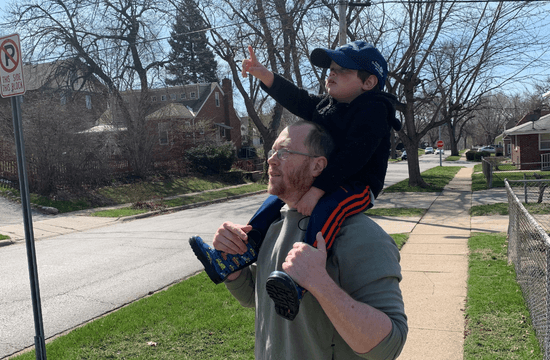
GO FOR A SOUND WALK
What you need:
- Energy and enthusiasm
How to do it:
Frequently the first sense we use when exploring is our sense of sight. For this walk, focus on your sense of hearing. Listen carefully. What do you hear? Then turn your head and try to see what you were listening to. You don’t need to be able to identify every bird sound to notice differences in their calls. Take a walk around your neighborhood early in the morning or in the evening. Listen carefully. Focus on the similarities and differences in the bird songs and sounds you hear.
- How many different kinds of bird calls do you hear?
- How many different kinds of birds can you see?
- Can you match the birds you see to the sounds you hear?
- Do you hear similar calls repeated by different birds?
MAKE HOMEMADE BINOCULARS
What you need:
- Two toilet paper rolls per person (or a paper towel roll cut in half)
- Tape
- Yarn or ribbon (optional)
- Markers, stickers, or other items for decoration
How to do it:
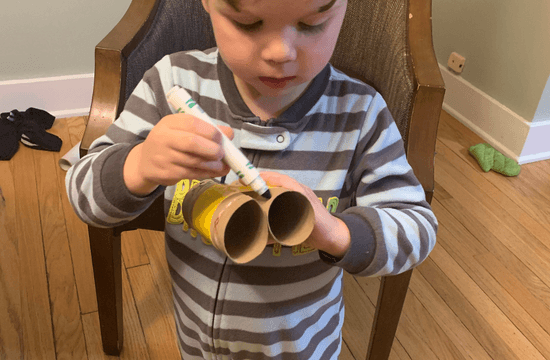
Use your creativity and imagination to make your own pair of spotting binoculars for bird watching. Although these binoculars won’t magnify what you see with them, they do help kids focus their attention. Creating binoculars also gives kids a new “toy” which makes bird watching more fun.
- Take two toilet paper tubes (some of you may have more of these than others) and tape them together.
- Use markers or stickers to decorate the toilet paper tubes.
- Use a hole punch to put one hole on the top outer part of each toilet paper tube. If you don’t have a hole punch, that’s fine! Just tape the yarn instead or leave the yarn off.
- Cut one piece of yarn large enough to make a necklace. Tie the yarn through each hole in the toilet paper tubes, giving the binoculars a strap.
Ask questions and keep exploring:
Asking your kids guiding questions about their observations will help them focus and allow them to notice details while learning about bird behavior and biology. Pose questions like:
- What is that bird doing?
- Look at the shape of that bird’s beak. What do you think it eats?
- Why do you think that bird is colored the way it is?
- Do you think that bird lives in our neighborhood all year long or do you think it migrates?
- How do you think that bird has adapted to living in a city versus living in a rural area?