

Save time, energy, and the environment.
Mowing is an inevitable task for most homeowners, but it doesn't have to be as hard as we make it. Bagging your grass clippings and fallen leaves is not only time and energy intensive, but also unnecessary.
Leaving cut grass and leaves on your lawn is a perfectly viable option to reduce the negative consequences of yard waste. It helps limit the resources spent to collect and commercially compost yard waste, making it an environmentally friendly way to maintain your yard. It also allows your lawn to organically feed itself by putting water and nitrogen back into the soil, all while cutting down on your own time and effort.
Here are a few tips to consider:
- Use Any Mower: Even though mulching mowers can be beneficial because they have extra blades to finely chop the grass, you do not need a special mower to mulch-mow your grass and leaves. Any mower will do the job as long as you keep your blades sharp.
- Mow When Dry: Avoid mowing when the lawn is wet because it can produce clumps.
- Mow Tall: Taller grass produces a deeper root system that uses water and fights diseases more efficiently. It also helps cut down on weeds. Ideally, set your blade at the highest setting and cut no more than 1/3 of the grass length.
- Leave it on the Lawn: Allow clippings to settle naturally into the soil to serve as an organic fertilizer. If clippings are long or thick, you can use a rake to spread it out evenly throughout the yard.
- Alternatives: Another option is to compost your grass and leaves onsite, or use it as mulch for your garden beds. Learn more about home composting here. *(Note: Be sure to review the City of Omaha's residential composting requirements at this link.)
Once you've established the pattern of reusing your mulch-mowed clippings over several seasons, your lawn turfgrass system should become more self-sustaining and require less investment in fertilizers and water over time.
Why rake when you can mow?
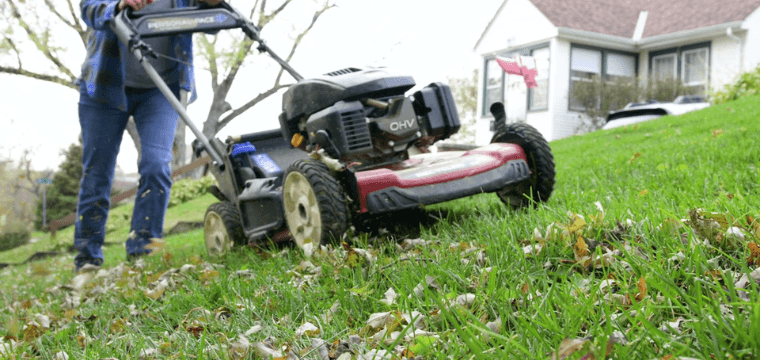
Mulching leaves with a lawnmower not only saves time and money, but it also adds important nutrients back into your soil. When mulched leaves decompose, they act as a natural fertilizer and weed control agent, keeping your lawn healthy and happy! Choosing to leave it on the lawn is quick and easy. It’s also an environmentally friendly way to maintain and prep your yard before winter hits.
Here are a few pointers…
- Start mulching when you can still see some grass poking up through the leaves, or when about 1/3 of your lawn is covered.
- Don’t mow after a rainy day, wet leaves won't chop well with a mower.
- You don’t need a special mower to mulch your leaves, a simple push or riding lawn mower with an adjustable blade will do the job.
- Simply adjust your mowers blades to the right height, remove the bag attachment, and mow the leaves and grass, letting the shredded leaves and grass blades remain on the lawn.
- Depending on how many leaves are on your lawn, you may need to mow over them several times to chop them small enough.
- Shoot for dime-size leaf pieces! The smaller the leaf pieces, the faster they will decompose.
- Be mindful not to mulch to the point where the leaves completely cover and smother the grass, this could end up killing the grass.
- If you end up with an abundance of mulched leaves, spread some in flower beds, gardens, or a home compost pile *(Note: Be sure to review the City of Omaha's residential composting requirements at this link.)